
Work orders
Work order management, from the report to the record
March 19, 2026 · 12 minute read
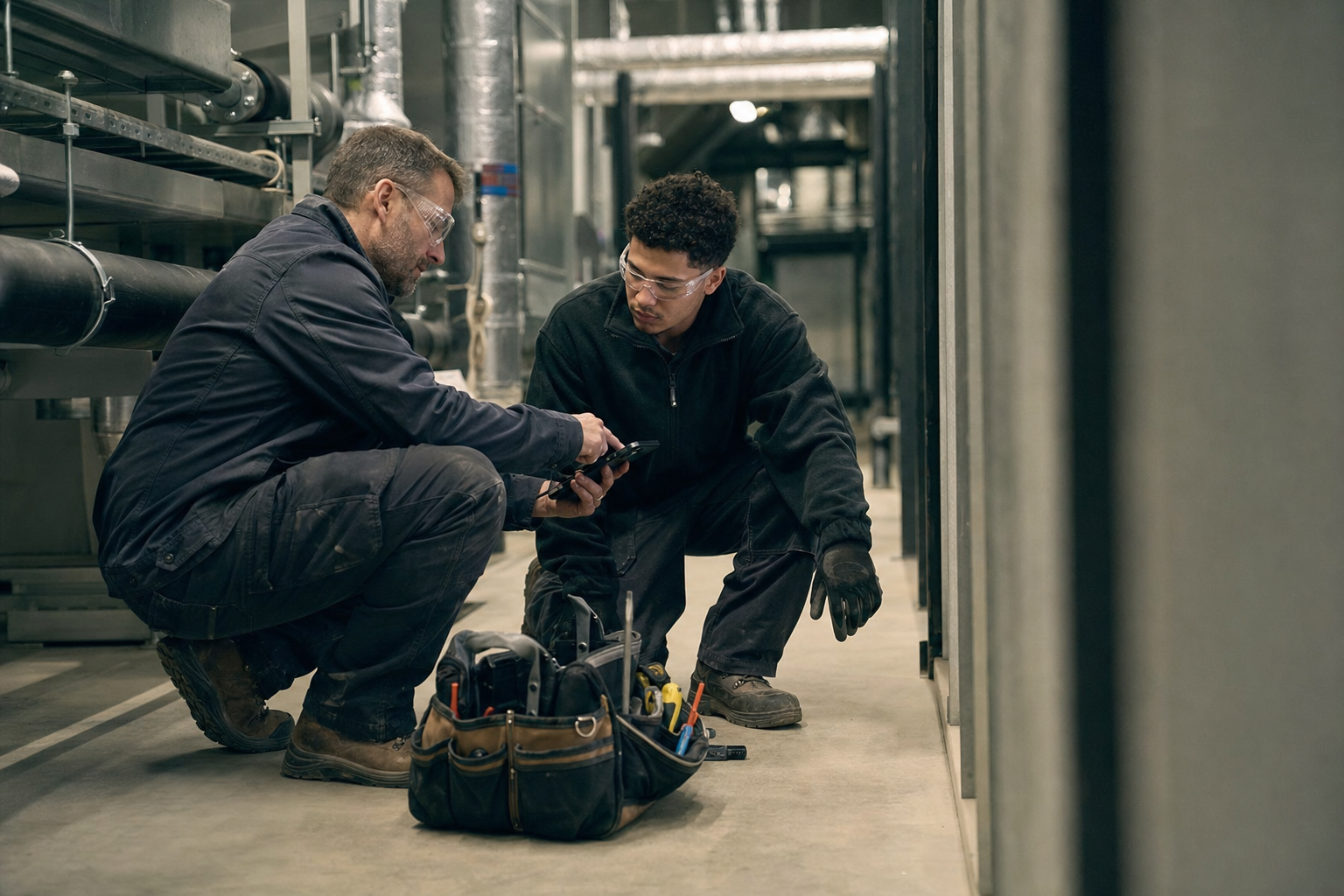
A work order is the record of one piece of work: what was asked for, who is responsible, what they did, and what they found. Work order management is everything that happens between somebody noticing a problem and that record being true and findable a year later.
Almost every facility team already has a work order system. Very few have one their technicians use properly, and the gap between those two facts is where most of the wasted effort in this job lives.
The five stages, and where each one leaks
- Report: somebody notices a problem. Leaks when reporting is harder than mentioning it in a corridor.
- Triage: somebody decides what it is and how urgent. Leaks when everything is urgent.
- Assign: somebody becomes responsible. Leaks when work is assigned to a person who is on holiday.
- Do: the work happens. Leaks when the record is written afterwards from memory.
- Close: the loop closes with the person who asked. Leaks almost always, which is why you get duplicates.
Make raising a job take thirty seconds
If reporting a problem is harder than mentioning it to somebody in a corridor, it will be mentioned in a corridor. A code on the wall, a photograph and a sentence is the bar. No account, no login, no category picker.
The objection is always that this produces rubbish. It produces more reports, and a portion of those are duplicates or trivial. That is a far better problem than the one you have now, which is work you never hear about until it is expensive.
Priority is about consequence, not about volume
Most priority schemes fail because everybody picks the top option. The fix is to define priority by what happens if it waits, and to write that definition on the screen where the choice is made.
- Someone could be hurt, or the building cannot be occupied: now
- The business cannot operate, or a legal requirement is breached: today
- It will get worse or more expensive if it waits: this week
- Everything else: on the plan
Attach the steps to the job
A work order that says "check the cooling tower" relies on the person knowing what checking it means. A work order that walks through the eight things to check produces the same result whoever is on shift, and produces a record as a side effect.
Capture evidence at the moment, not afterwards
Photographs taken in the app, at the step that asked for them, end up attached to the job. Photographs taken on a personal phone end up in a camera roll. The difference is entirely about when you ask.
Let people say no
A technician who cannot record "I could not do this, and here is why" has two options: pretend it is done, or let it go red. Both are worse than the truth. Giving them a way to turn work back with a reason and a photograph is the single change that most improves data quality, because it removes the incentive to lie.
Close the loop with the person who asked
The tenant who reported the leak does not know it was fixed unless somebody tells them. Nobody has time to tell them by hand, so nobody does, so the tenant reports it again. Automating that one message removes a surprising amount of noise from the list.
What to measure
Not the count of jobs closed, which rewards closing small ones. Four measures change decisions.
- Requests with no first response, which is what a tenant actually experiences
- Median time to complete by priority, not the average, which one job waiting on parts will wreck
- Repeat faults on the same asset within ninety days
- The proportion of closed jobs carrying evidence
What good looks like six months in
- Anyone in the building can raise a job without an account
- Duplicate reports merge rather than multiply
- Finished work carries photographs and times without anybody being asked
- Late work is visible and specific
- A technician can refuse a job honestly
- You can produce the record of any job from a year ago in under a minute