
Analytics and reporting
The numbers your review is actually about
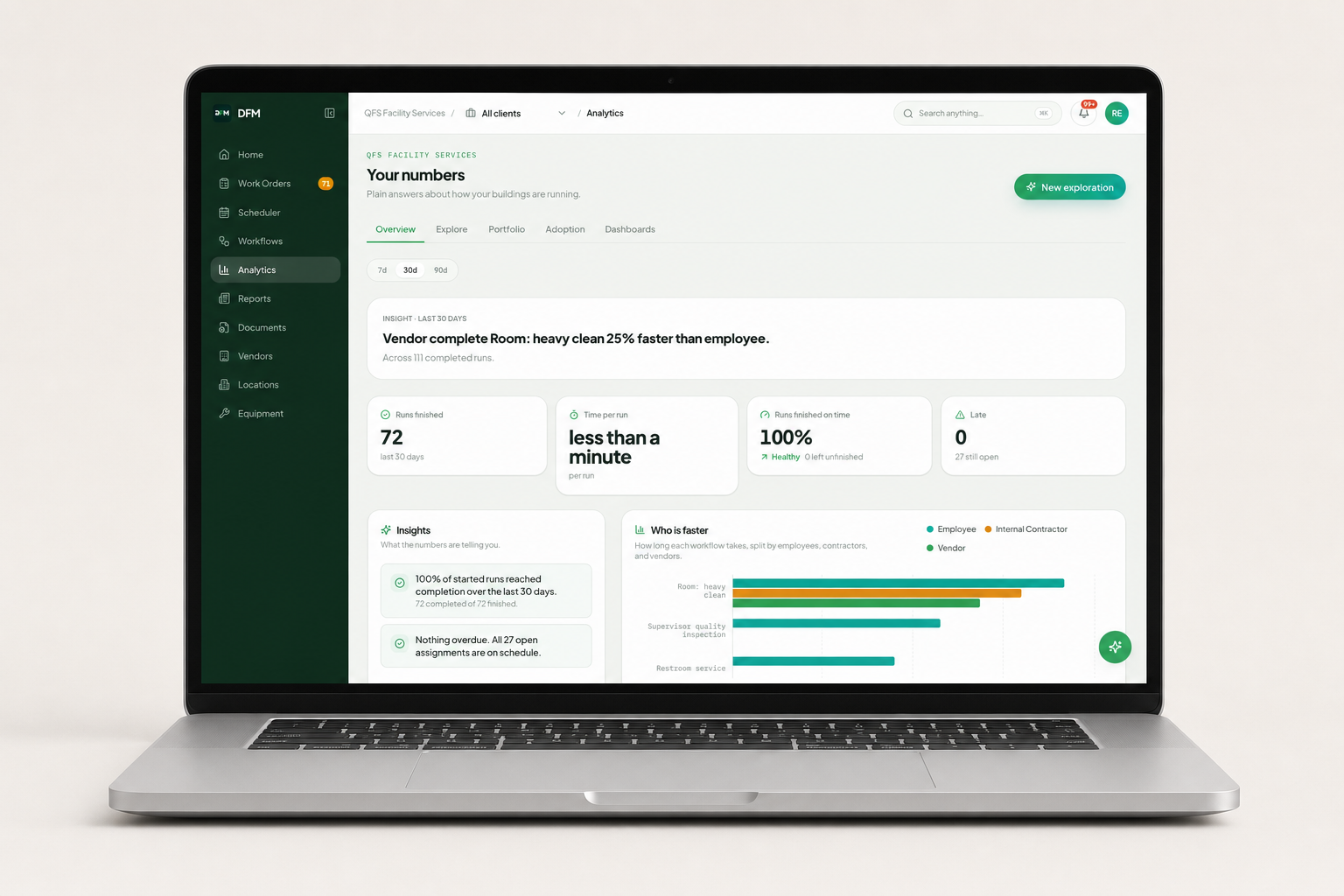
Facility reporting usually measures how diligently a system was filled in. Because DFM captures work as it is performed, the measures come out of the operation itself, which is what makes them worth putting in front of an owner.
- Calculated from completed work
- Traceable to source jobs
- Exportable to your warehouse
The measures
What a facility leader is held to
Each of these is reported per site, per client and per team, and every figure opens onto the jobs behind it.
Planned-to-reactive work mix
The largest single driver of cost per square foot, trended so you can show direction as well as level.
PM compliance rate
Completion against schedule, by site and programme, against a top-quartile benchmark of 91 percent.
SLA attainment and MTTR
Response, attendance and resolution measured from the work, not estimated from email.
Cost and demand by site
Which buildings consume the labour, which consume the contracted spend, and which do both.
Repeat failures
Assets and faults that recur, so correction can be aimed at the cause rather than the symptom.
Labour and vendor productivity
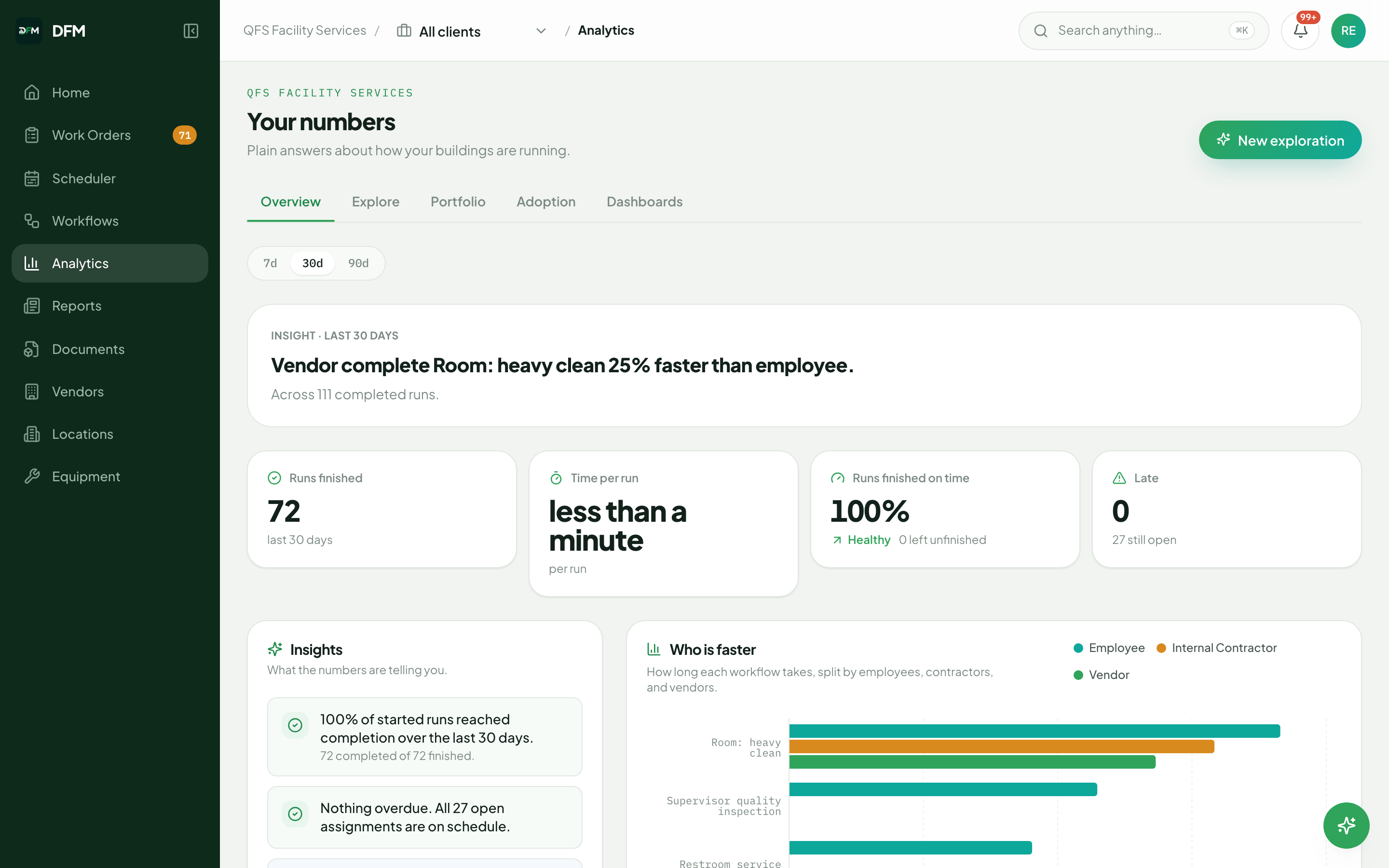
Staff, internal contractors and vendors on the same scope, compared on completion time and evidence rate.
Reading it
The finding first, the chart underneath
Most dashboards leave the reasoning to the reader. DFM leads with the finding as a sentence and shows the working beneath it, so a busy executive takes the point immediately and an analyst can still audit it back to individual jobs.
- Every figure traceable to the completed work behind it
- Filter by site, client, team, trade or individual
- Median rather than mean for durations, because facility work has a long tail
- CSV export and API for the warehouse your finance team already uses
Distribution
The recurring pack, produced rather than assembled
Owner reports, client service reviews and internal operating reviews all run on a schedule and all consume days of somebody’s month. Set the recipients and the frequency once, and the pack goes out with live figures and the evidence attached.
Questions people ask
- How much configuration is needed before the reporting is useful?
- None for the core measures, because they are derived from the work itself. Custom views sit on top of that.
- Can we get the underlying data into our own warehouse?
- Yes, through CSV export, the versioned REST API, or signed webhooks for event-level streaming.
- Do these figures reconcile with our finance system?
- They are operational measures: labour time, attendance, completion and evidence. Reconciliation to spend is normally done by feeding them to finance through the API rather than by duplicating a general ledger here.
Keep reading
- Reports and EvidenceThe expensive gap in facility operations sits between doing the work and being able to demonstrate it.Open
- IntegrationsFacility platforms that will not release their data become the thing every other team works around, and the estate en...Open
- Scheduling and DispatchMost maintenance schedules are built on estimates nobody has checked, which is why they are fiction by Wednesday and ...Open
Ready to see DFM in action?
Book a demo and see the platform running against a building like yours.