
Platform overview
Move work from reactive to planned, and prove it
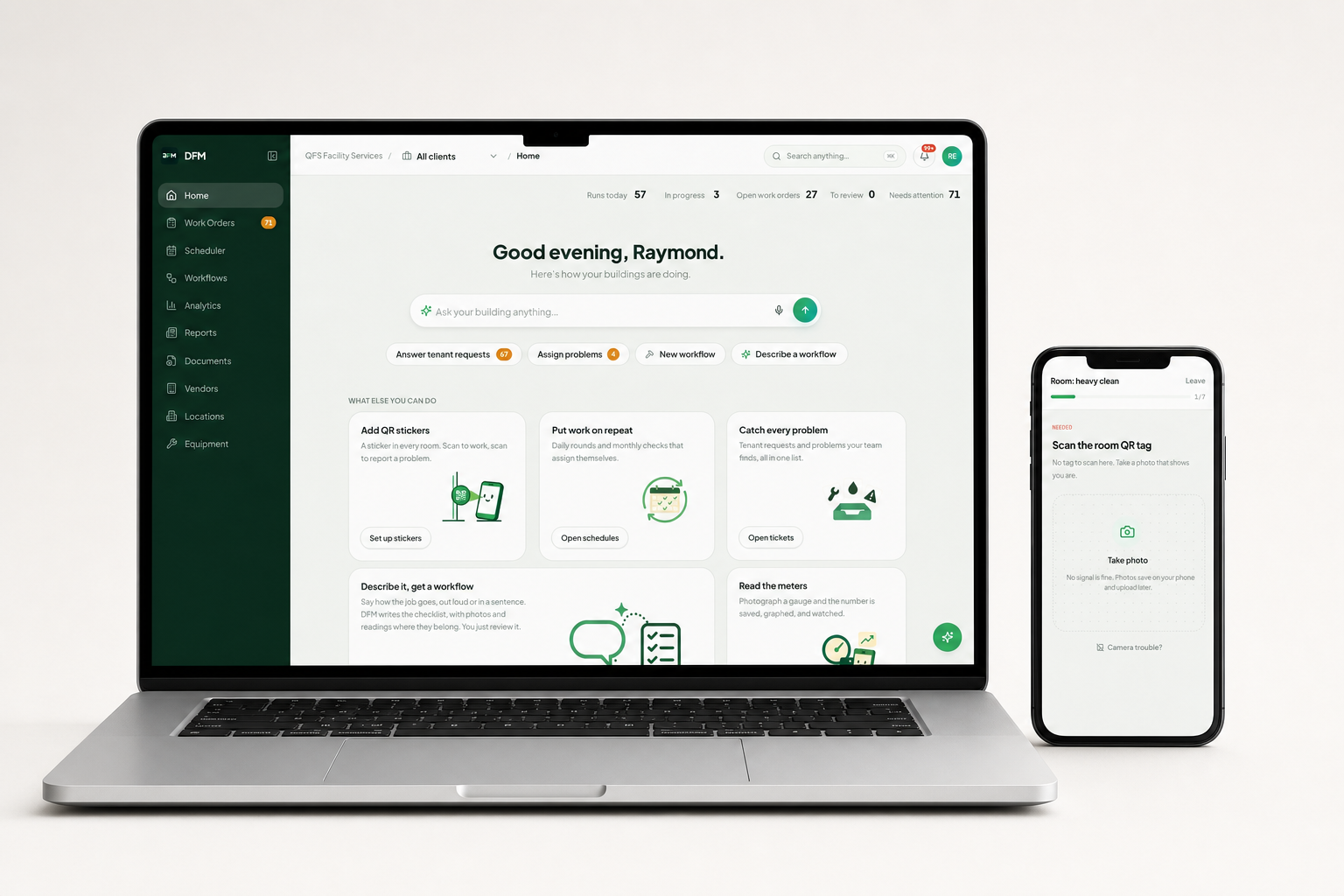
DFM consolidates work orders, inspections, preventive maintenance, assets and vendor management into one operating record. Facility leaders use it to hold down cost per square foot, defend a capital plan, and answer an auditor in minutes rather than weeks.
- One system of record
- Live in weeks, not quarters
- Deploys to every site at once
The cost of the status quo
The work mix is the budget
Facility cost is driven less by rates than by how much of the work is unplanned. These are the benchmarks your operation is measured against, and the gap between the median and the top quartile is where a platform has to earn its keep.
- 3 to 5x
- What a reactive repair costs against the equivalent planned work
- $2.80 to $3.50
- Median commercial office maintenance cost per square foot per year
- 91%
- Top-quartile PM compliance rate
- 3 to 5%
- Annual compounding of deferred maintenance backlog in weaker operations
Figures are published industry benchmarks from IFMA and BOMA operating-cost surveys, not DFM customer results.
What a platform has to do
Three jobs, and they only work together
Most facility teams have already bought at least two of these separately and joined them with a spreadsheet. The join is where the cost and the risk sit.
Control cost
Raise the planned share of work, plan against the real duration of every job, and find the assets that keep coming back before they take the capital budget with them.
Reduce risk
Statutory testing, life safety and environment of care rounds run on schedule, and a failed check becomes tracked corrective work with an owner and a date rather than a note.
Prove performance
Every completed job carries the evidence it was done, so an audit, an owner report or an SLA dispute is a search rather than a reconstruction.
Capability
Manage work
Intake, triage, assignment and the day it all has to fit into.
Smart Work Orders
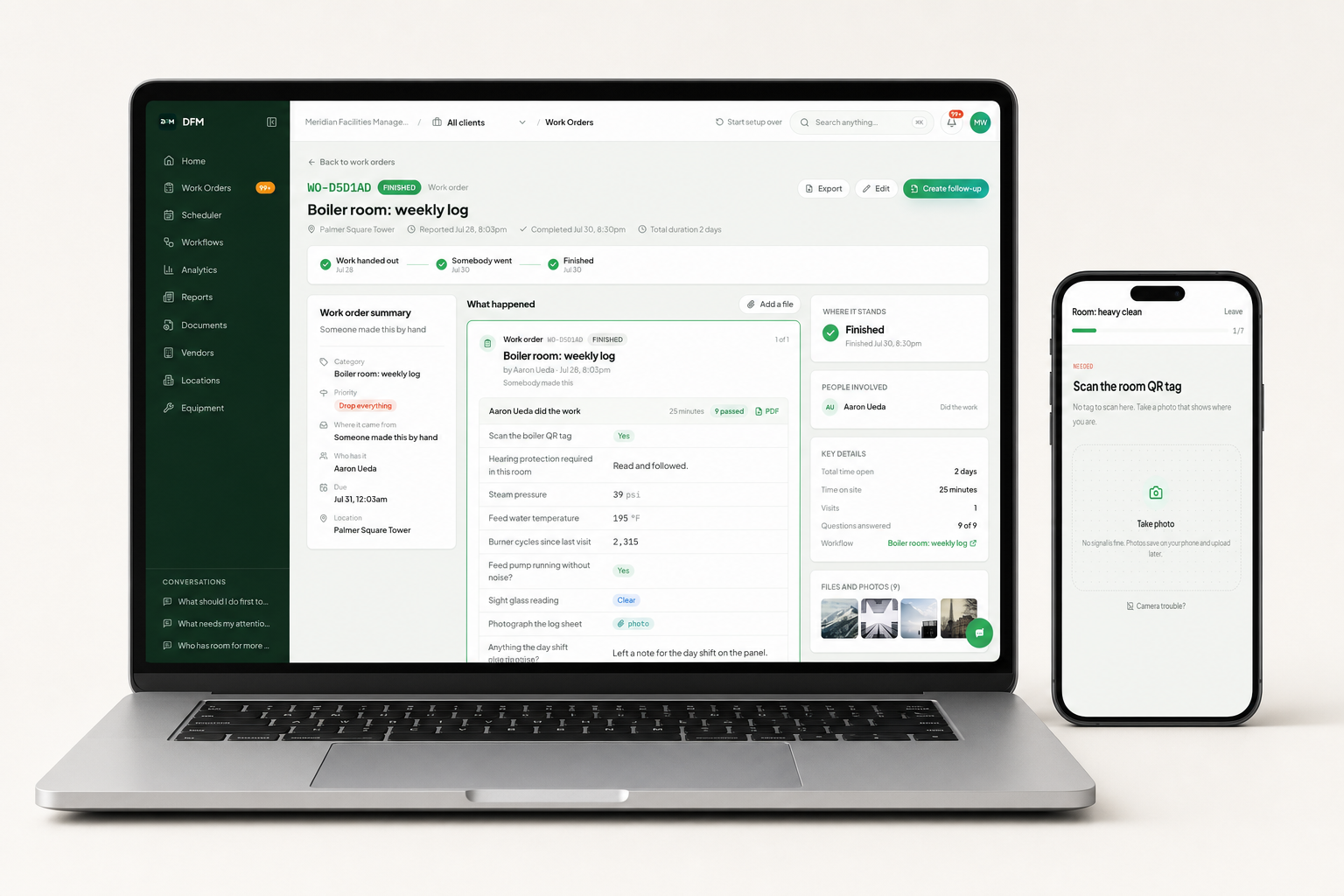
One record from first report to sign-off, with time on site, cost attribution and evidence attached.
Workflow Automation
Standardise a procedure once and enforce it at every site, in every language your crews read.
Scheduling and Dispatch
Plan capacity against recorded durations, and see who is overloaded before the week starts.
Requests
Capture the demand that currently arrives by email and never reaches a system at all.
Operate and maintain
The programmes that decide your condition index and your survey outcomes.
Inspections and Compliance
Statutory and internal rounds with time, place and photographic evidence attached to each check.
Assets and Equipment
A register with full service history and condition readings, so capital decisions have a basis.
Vendor Management
Verified attendance and evidence for contracted work, with insurance expiry tracked.
Mobile App
Field execution that works with no connectivity, which is why the record comes back complete.
Report and improve
What you take to the owner, the board and the renewal conversation.
Analytics and Reporting
Work mix, PM compliance, SLA attainment, cost by site and repeat failures, from live work.
Reports and Evidence
Owner packs and audit evidence produced from the record, on a schedule, without assembly.
AI for Facilities
Standardise two hundred undocumented procedures in weeks instead of quarters.
Integrations
REST API, signed webhooks, MCP and exports, so DFM feeds the systems finance already runs.
Why the record is trustworthy
A platform the field works around reports numbers you cannot defend
The usual failure is not selecting the wrong system. It is selecting one the technicians work around, so jobs get closed in a batch on Friday with no evidence, and by the second quarter the compliance report describes data entry rather than the estate. DFM is built so the record is a by-product of doing the work.
- Procedures execute at the asset, so completion is captured there rather than typed up later
- Photographic evidence and meter readings are required at the step that needs them
- Scanning the asset tag establishes who attended, when, and at which unit
- Work completes with no connectivity, which is where most facility work happens
- A technician can formally decline a job with a reason, so the data stops rewarding false closure
Enterprise readiness
What IT, security and procurement will ask
Isolation and access
Tenant isolation enforced in the database rather than in application code, with access scoped by site and by client.
Integration and exit
A versioned REST API, signed webhooks, an MCP server and CSV export. Full extraction at any time, with no exit fee.
Rollout
One programme live in days. We build your procedures with you rather than handing over an empty system.
Consolidation
What this replaces
Most estates are already running four of these, on separate contracts, with the joins done by hand.
- A CMMS for work orders and preventive maintenance
- A separate inspection or audit application
- A vendor portal nobody outside the company logs into
- Spreadsheets for the asset register and capital planning
- A shared drive of photographs used as evidence
- Email as the intake channel for tenant and staff requests
- A reporting pack assembled by hand every quarter
- Paper for anything that happens where there is no signal
We have better visibility, faster response times, and our audit readiness is night and day.
Questions people ask
- How long until we are live, and what does implementation cost?
- Most estates have one programme running within days and the rest inside a quarter. Implementation is quoted separately and plainly, based on how much history you want migrated and how many procedures you want us to build with you. Enterprise platforms commonly add $20,000 to $100,000 of services in year one, and we would rather tell you the number during evaluation than at signature.
- How does this reduce cost rather than just record it?
- By moving work from reactive to planned. Industry benchmarks put a reactive repair at three to five times the cost of the equivalent planned work, which makes the ratio the largest single lever on cost per square foot. DFM makes late preventive work visible daily, plans against recorded durations rather than guesses, and surfaces the assets that keep failing.
- Will this survive contact with our technicians and contractors?
- That is the risk we design against, because a platform the field works around produces reporting you cannot defend. Procedures run with no connectivity required, contractors work from a link with no account to create, and technicians can decline work with a reason instead of falsifying a closure.
- Can we keep our existing procedures and asset data?
- Yes. We rebuild your current forms, rounds and PM schedules as guided procedures, and import your asset register in whatever state it is in. Most estates start with a register that is partly out of date and correct it as technicians scan units in the field.
- What happens to our data if we leave?
- You take all of it, through CSV export or the API: work, evidence, assets, people and reporting. There is no extraction fee and no proprietary format.
Keep reading
- PricingPer-user pricing is why facility software ends up with three shared logins across forty people, and shared logins des...Open
- Inspections and ComplianceThe question that decides an audit is never whether you inspect.Open
- SecurityYou are putting the operating record of your buildings into somebody else’s software.Open
- All solutionsBy industry and by the job to be done.Open
Ready to see DFM in action?
Book a demo and see the platform running against a building like yours.