
Assets and equipment
Capital decisions with a service history behind them
Repair or replace is the most expensive recurring judgement a facility team makes, and in most estates it is made from memory. A register that carries every intervention and every reading turns it into an argument you can win in a budget meeting.
- Complete history per asset
- Condition readings trended
- Tag-initiated work, filed correctly
What it changes
Questions a register has to answer
If any of these takes more than a search, what you have is a list rather than an asset history.
When was this last serviced, and by whom?
The last completed job against this unit, internal or contracted, with its evidence.
Is its condition deteriorating?
Readings held as numbers and trended per asset, so drift is visible long before failure.
How often does it fail?
Every deficiency raised against the unit since it entered the register, with the intervals between them.
What have we spent on it?
Attendance, repeat visits and contracted work attributed to the asset rather than to the building.
Where is the documentation?
Manuals, certificates and warranty terms on the record a technician opens standing in front of the unit.
What condition is the estate in?
Asset-level condition rolled up by site, which is the input a Facility Condition Index needs.
Data quality
A tag on the unit is how the register stays true
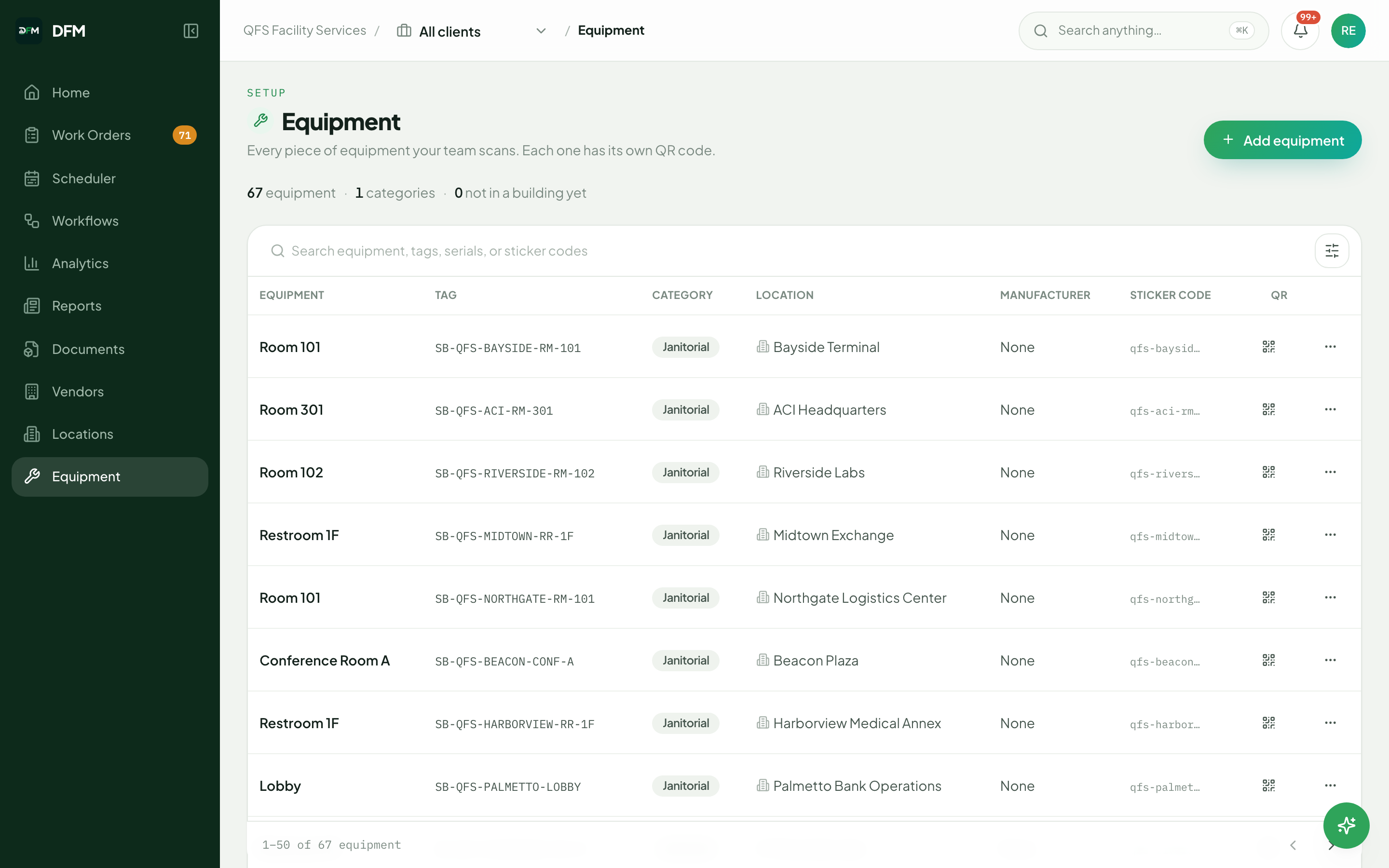
Asset registers rot because keeping them current is somebody’s separate job. Tagging rooms and equipment makes maintaining the register a side effect of working: a scan opens the correct record, work files against the right unit, and the register is corrected by the people standing in front of it.
- A scan opens the asset, its history and its open deficiencies
- Work cannot be filed against the wrong unit by mistyping an identifier
- Faults reported against the equipment, with a photograph, in seconds
- Reprinting a tag changes nothing, because the code addresses the asset
Why condition data pays
Deferred maintenance compounds quietly
A backlog is invisible on a profit and loss statement until it arrives as a capital request. Asset-level condition data is what turns it into a number you can present before that point.
- Below 0.05
- Facility Condition Index of a well-maintained estate
- Above 0.10
- Facility Condition Index signalling an urgent capital need
- 3 to 5%
- Annual compounding of deferred maintenance backlog in weaker operations
- 3 to 5x
- Cost of a reactive repair against the same work planned
Figures are published industry benchmarks from IFMA and BOMA operating-cost surveys, not DFM customer results.
Questions people ask
- Can we import an asset register we already have?
- Yes, including from spreadsheets and from a previous system. Most estates start with a register that is partly wrong and correct it as technicians scan units in the field.
- Do we have to tag everything before we start?
- No. Assets can be selected from a list until tags go up, and tagging usually follows the first programme rather than preceding it.
- Can asset data feed our capital planning?
- Yes, through export or the API. Condition readings, failure history and spend by asset are the inputs a renewal model needs.
Ready to see DFM in action?
Book a demo and see the platform running against a building like yours.