
Smart work orders
Work orders that stand up in a cost review
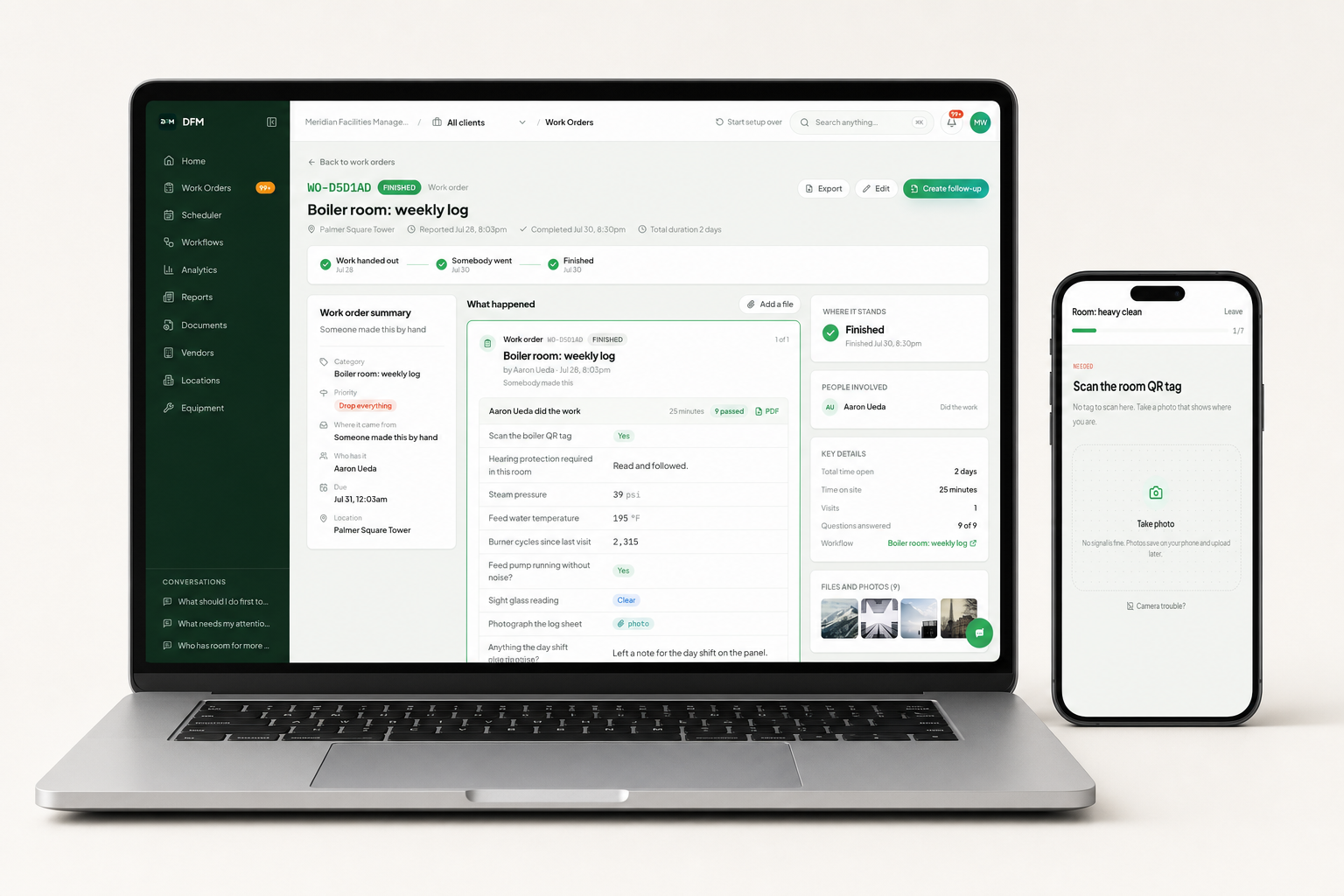
A work order is the unit your budget, your SLA reporting and your audit trail are all built from. If it records a status and a date, none of those three can be defended. DFM records the whole transaction: demand, decision, labour, evidence and outcome.
- SLA measured, not estimated
- Evidence captured at the asset
- Cost attributable to site and asset
What it changes
Three reporting problems this closes
Response and resolution become measurable
Time to acknowledge, attend and resolve is captured from the work itself, so SLA attainment stops being a monthly estimate assembled out of email.
Cost lands on the right site and asset
Labour time, contractor attendance and repeat visits attach to the building and the equipment, so cost per square foot can be interrogated rather than allocated.
Closure means something
A job closed with no evidence behind it is visible as such. That single fact is what makes the completion rate in your board pack worth quoting.
The record
The whole transaction, in the order it happened
Open a completed work order and read down it: the original request in the words the reporter used, the triage decision, who attended and when, each step they answered, the readings they took, the deficiencies they raised, and the sign-off. Nothing is reconstructed afterwards, which is why it survives a dispute.
- Demand captured verbatim, before anybody categorised it
- Attendance and time on site recorded at the asset
- Every answer and photograph in sequence
- Deficiencies raised during the job, tracked separately with their own owners
- Follow-up work linked back to the job that caused it
Demand capture
Four ways work enters, one queue
Most estates lose a share of their demand before it reaches a system, because reporting it is harder than mentioning it to somebody in a corridor.
Occupant and tenant reports
A link or a QR code, no account, a photograph attached. This is the demand you currently receive by email and in person.
Preventive schedules
Statutory testing and planned maintenance generate and assign themselves, which is what holds the planned ratio up under pressure.
Asset-initiated work
A scan at the equipment opens the right procedure for that unit, so work files against the correct asset every time.
Inspection deficiencies
A failed check becomes tracked corrective work with the evidence already attached and an owner assigned.
Assignment
Dispatch tightly, or delegate by deadline
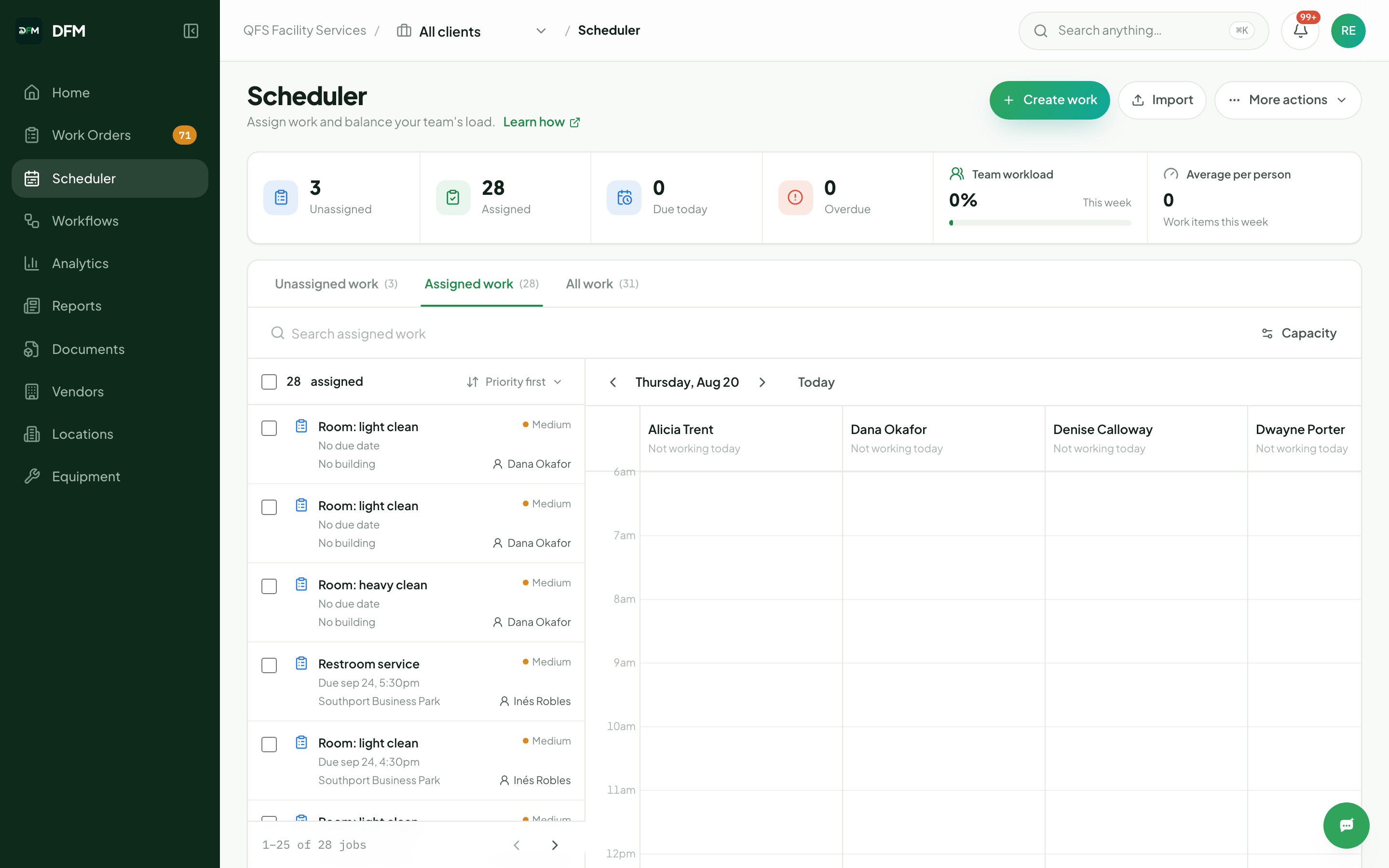
Contracted service and shift work need every job placed on a person and a time. Skilled trades covering their own patch work better with a list and a date. A dispatch model that only supports the first gets abandoned by the second quarter, and the estate goes back to phone calls.
- Assign to an individual, a team or a contracted vendor
- Escalation when work passes its due date, to somebody who can move resources
- Late work reported as how late, so this morning and last quarter are not the same colour
- Formal decline with a reason and photograph, instead of silent non-completion
Why the work mix matters
The ratio, not the rate, is the lever
Rates are negotiated once a year. The planned-to-reactive ratio is decided every week, and it moves cost per square foot considerably further.
- 3 to 5x
- Cost of a reactive repair against the same work planned
- Above 80%
- Planned work ratio maintained by top performers
- 91%
- Top-quartile PM compliance rate
- Under $2.50
- Top-quartile maintenance cost per square foot per year
Figures are published industry benchmarks from IFMA and BOMA operating-cost surveys, not DFM customer results.
Questions people ask
- How is this different from a service desk or ticketing system?
- A ticketing system records the conversation about work. DFM records the work itself: the procedure followed, the readings taken, the evidence captured and the time spent, from the device of the person doing it. That difference is what makes the resulting cost and compliance data defensible.
- Can we migrate open work and history from our current system?
- Yes, from an export or a spreadsheet, as part of the rollout. Open work moves first so nothing is lost at cutover. How much history comes across is a scoping decision and affects the implementation quote.
- Can a technician refuse a job?
- Yes, with a reason and a photograph, and it returns to the manager. This matters more than it looks. Without it the only options are falsifying a closure or letting the job run red, and both corrupt the data you report on.
- How do we report SLA attainment to a client?
- From the record, filtered by client and site, with the underlying jobs attached. Scheduled client reports go out without anybody assembling them.
Keep reading
- RequestsRequests arrive by email, by text, at a service desk and in a corridor.Open
- Scheduling and DispatchMost maintenance schedules are built on estimates nobody has checked, which is why they are fiction by Wednesday and ...Open
- Work Order ManagementMost work order implementations do not fail at selection.Open
- Reports and EvidenceThe expensive gap in facility operations sits between doing the work and being able to demonstrate it.Open
Ready to see DFM in action?
Book a demo and see the platform running against a building like yours.