
Requests
Capture the demand you are currently not seeing
Requests arrive by email, by text, at a service desk and in a corridor. Whatever share of them never reaches a system is invisible to your reporting, unmeasured against your SLA, and missing from the case for next year’s budget.
- No account required
- Location and evidence attached
- Duplicates merged, every reporter still notified
What it changes
Three things unmeasured demand costs you
Your volumes are understated
A resourcing case built on the demand that happened to be logged argues for less than the estate actually consumes.
Your SLA is unprovable
Response time cannot be measured from the moment somebody mentioned it in a corridor. It can be measured from a logged request.
Occupants assume nothing happened
Most complaints about facilities are complaints about not being told. Closing the loop removes a large share of repeat reporting.
Triage
A request is not a work order until you decide it is
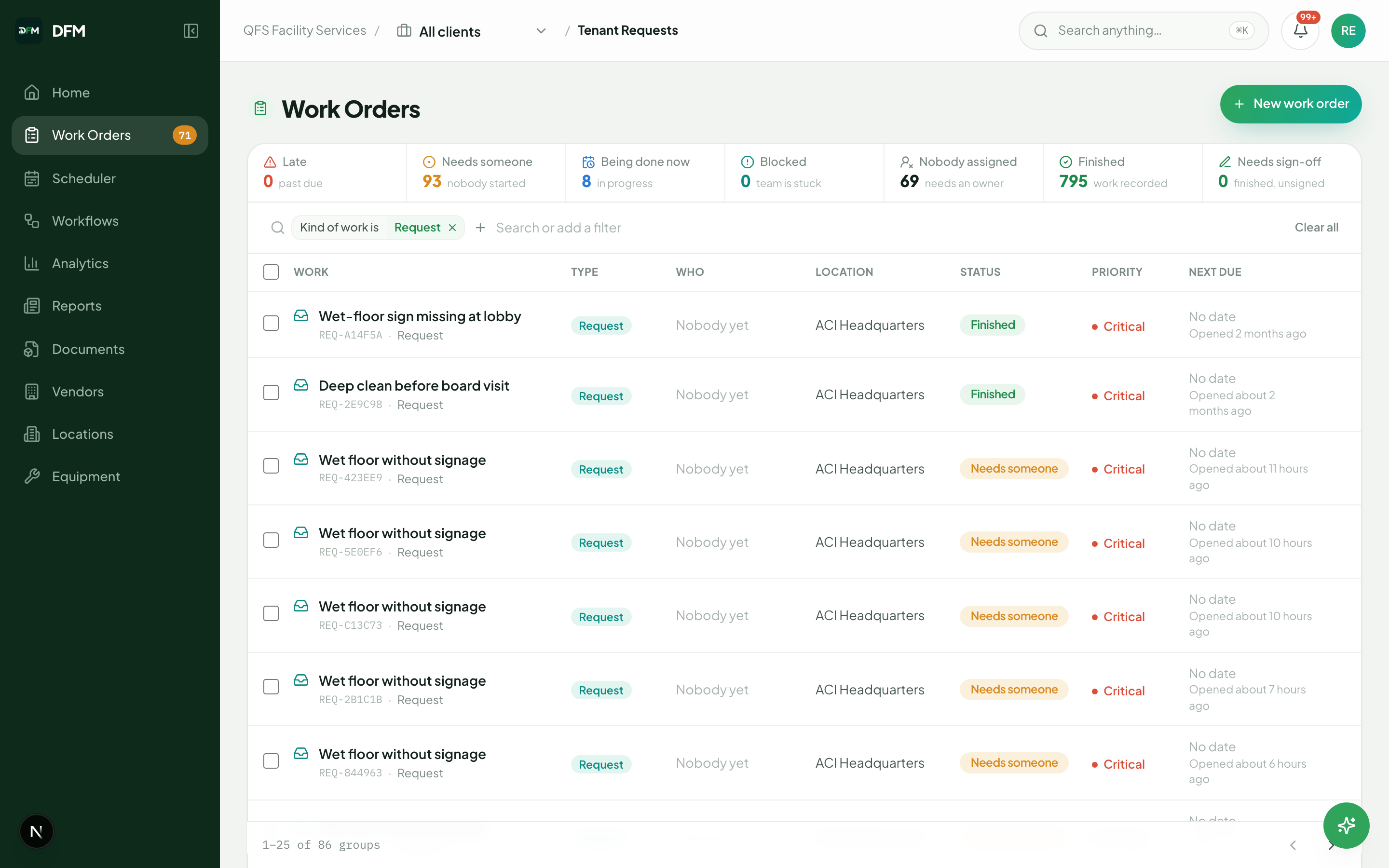
Keeping the two apart matters for reporting. A request is somebody’s description of a problem; a work order is the decision you made about it. DFM preserves the original wording, then converts it into planned work with the right procedure attached.
- The reporter’s own words kept, not a category somebody selected
- Duplicate reports of the same fault merged into one job
- Conversion to work with the correct procedure in one action
- Automatic notification back to everybody who reported it
Who reports
Three populations, one channel
Tenants and occupants
A QR code in the lobby or a link in the tenant handbook. No account, nothing to install, a photograph attached.
Your own staff
A technician on another job reports a fault in seconds without leaving the work they are doing.
Contractors on site
The people in the plant room more often than you are, reporting into the same queue.
Questions people ask
- Do tenants need accounts?
- No. A request is a web page reached from a link or a QR code. Requiring an account is the single biggest cause of unlogged demand.
- How do we stop the queue filling with duplicates?
- Repeat reports of the same fault merge into one work order, and everybody who reported it is still notified when it closes.
- Can this sit behind a tenant portal we already run?
- Yes. The API and webhooks let an existing portal submit into the same queue and read status back.
Keep reading
- Smart Work OrdersA work order is the unit your budget, your SLA reporting and your audit trail are all built from.Open
- Commercial Real EstateIn commercial real estate, maintenance is not a cost centre to be minimised.Open
- IntegrationsFacility platforms that will not release their data become the thing every other team works around, and the estate en...Open
Ready to see DFM in action?
Book a demo and see the platform running against a building like yours.