
Scheduling and dispatch
Plan capacity against what work actually takes
Most maintenance schedules are built on estimates nobody has checked, which is why they are fiction by Wednesday and why preventive work is the first thing dropped. DFM plans against the recorded duration of your own completed jobs.
- Durations from your own completed work
- Deadline-based work stays first class
- Overload visible before the week starts
Capacity
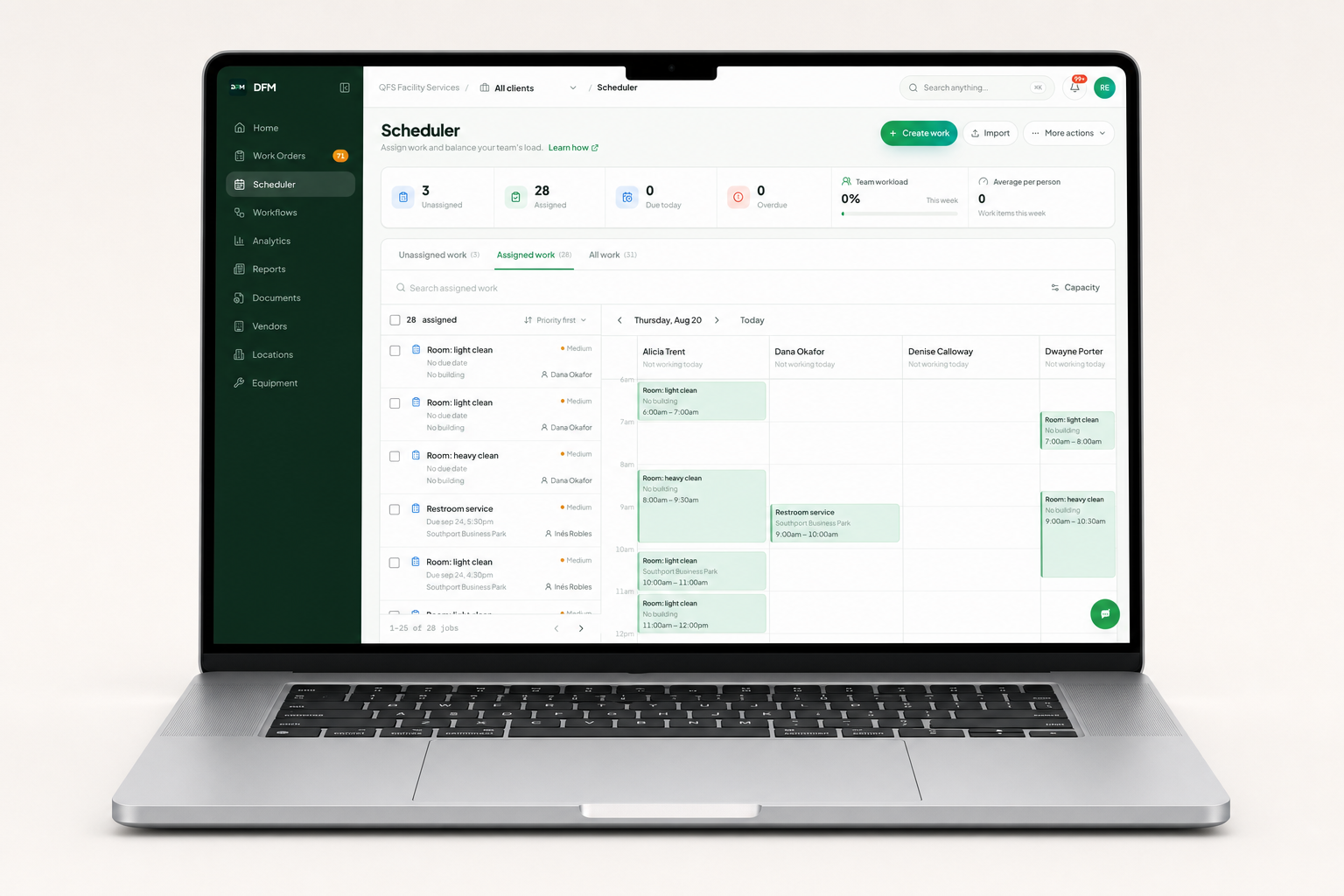
One lane per person, and an honest picture of the week
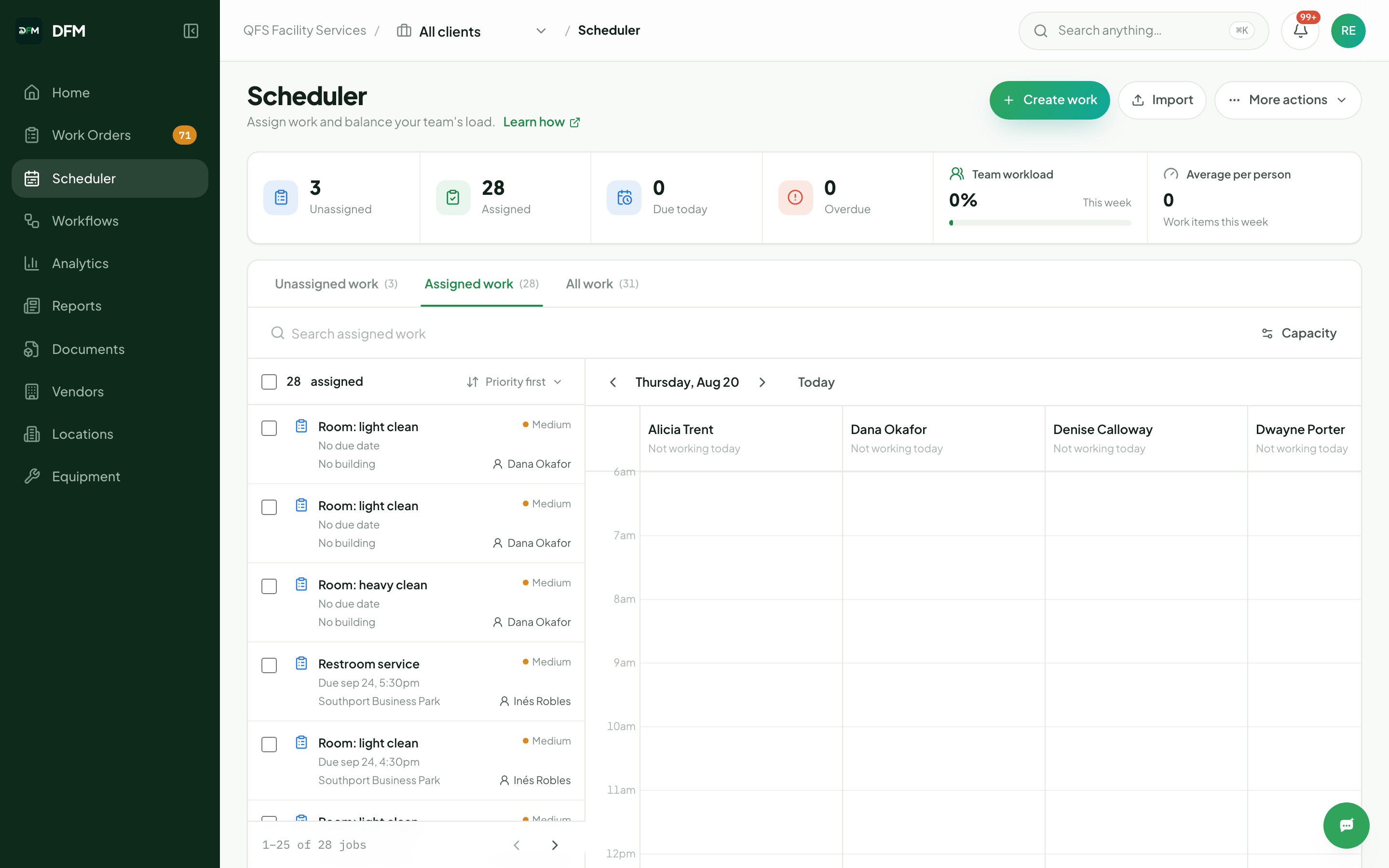
Unassigned demand sits on the left, each technician has a lane, and placing a job commits capacity. The value is not the drag and drop. It is that on Monday you can see which technician is carrying eleven hours of work in an eight hour day, and decide about it before the estate finds out.
- Committed capacity per person, per day
- Deadline-only work stays visible instead of falling off the calendar
- Deliberately placed work is never displaced by an automatic due-date sort
- Contracted vendors planned on the same board as internal labour
Estimates
Durations taken from completed work, not from a guess
DFM reads the completed runs of each procedure and gives every screen one number. It uses the median rather than the mean, because facility work has a long tail and one job that waited three weeks for a part should not move next week’s plan. The slow end is shown separately, so the risk in a plan is visible rather than assumed away.
- A new procedure can be given a duration by hand until it has history
- Estimates tighten as the team gets faster, without anybody maintaining them
- The spread is drawn, so a plan can be built to a known confidence
Protecting the plan
How preventive work stops being the shock absorber
Late PM is a number, daily
Preventive work past its date is counted on the screen managers open each morning, by site. A number gets defended in a resourcing conversation. A vague unease does not.
Load spread across a pool
Recurring work draws from a group rather than always landing on the same person, which removes both the single point of failure and the resentment.
Escalation that reaches authority
Overdue work escalates to somebody who can move resources, naming the site and the job, rather than reminding the person who already knows.
What it prevents
Failures a dispatch board is bought to stop
- A technician committed to eleven hours of work in an eight hour day
- Two people dispatched to the same fault
- Recurring statutory work quietly failing to generate
- A plan nobody looks at after Monday morning
- Preventive maintenance absorbing every reactive surprise
- Travel between sites that nobody planned for
Questions people ask
- Do we have to schedule everything to a time?
- No. Work with a deadline and no start time is a first-class case and stays visible. Forcing every job onto a clock is the usual reason a scheduler gets abandoned.
- Where do the duration estimates come from?
- Your own completed runs of that procedure, using the median. Until there is enough history you set a duration by hand, and it is used until the data overtakes it.
- Can contracted vendors be planned alongside internal staff?
- Yes. A vendor receives the job as a link, attends, works through the same procedure and checks out, so their time appears on the same board and in the same reporting.
Keep reading
- Smart Work OrdersA work order is the unit your budget, your SLA reporting and your audit trail are all built from.Open
- Preventive MaintenanceEvery facility team has a preventive maintenance schedule.Open
- Vendor ManagementMost of a facility budget is spent with companies you cannot supervise.Open
- Analytics and ReportingFacility reporting usually measures how diligently a system was filled in.Open
Ready to see DFM in action?
Book a demo and see the platform running against a building like yours.