
Workflow automation
One standard, enforced at every site
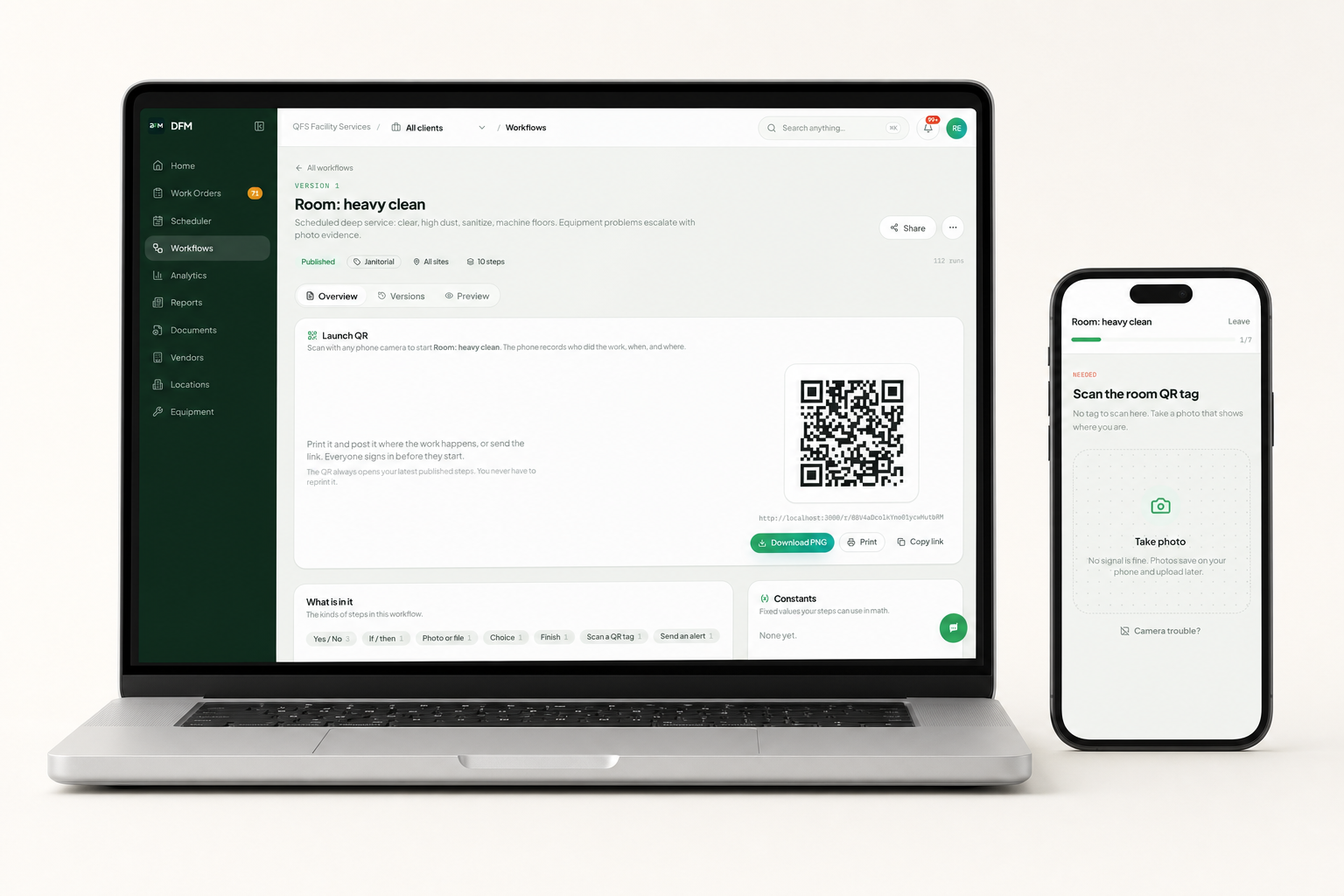
In most estates the procedure lives in the head of the longest-serving technician at each building. That is why quality varies by site, why turnover is expensive, and why nobody can state what was actually checked. Writing it down once, and executing it at the asset, addresses all three.
- Published to every site at once
- Conditional on the answer
- A run completes on the version it started
What it changes
What an undocumented procedure costs
Turnover stops being an outage
When the procedure is in the system rather than in one person, losing a twenty-year technician costs you experience rather than capability.
Sites become comparable
Two buildings running the same procedure produce data you can put side by side. Two buildings running local variants produce an argument.
Scope becomes provable
A procedure with defined steps lets you demonstrate what was checked, not merely that somebody attended.
What a step can be
Enough to encode real work
Enough step types to carry a statutory test, few enough that a manager builds one without a consultant.
Pass or fail
The backbone of every check. A failure raises tracked corrective work on its own.
Metered reading
Pressures, temperatures and hours run, stored as numbers with thresholds and trended per asset.
Photographic evidence
Required at the step that needs it, filed against that step rather than into a camera roll.
Asset verification
A tag scan establishes attendance at the correct unit.
Conditional branching
Skip what does not apply to that unit, and go deeper when a reading is out of range.
Immediate notification
A failed safety check alerts the responsible person at the moment it fails, not at the end of the round.
Controlled choice
A fixed answer set, so the same condition is recorded the same way by every person.
Sign-off and notes
Signature capture for statutory records, and free text for what the form never anticipated.
Getting there
Two hundred procedures is the real project
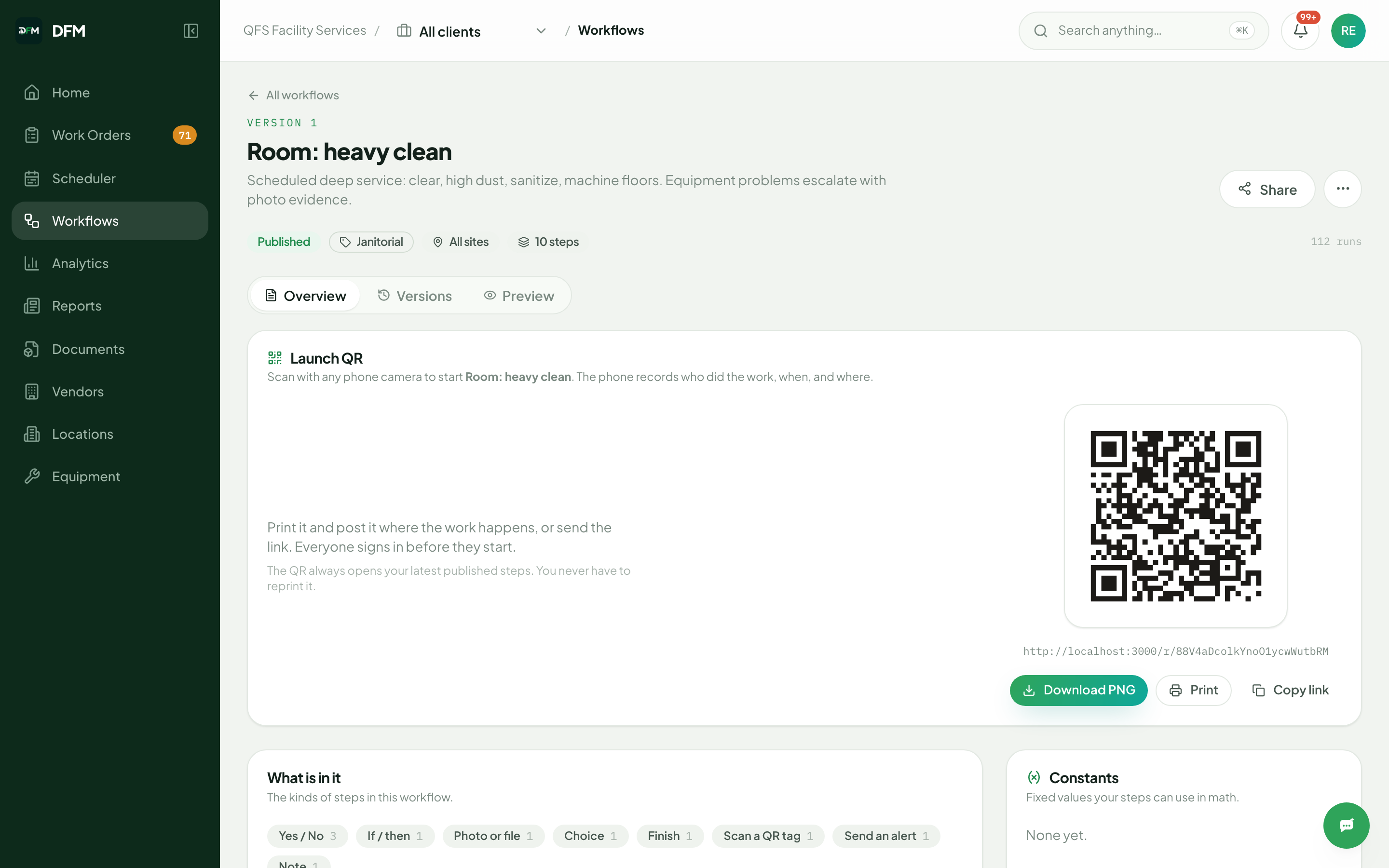
The software is rarely what makes a rollout take a year. Documenting the procedures is. So DFM lets a manager describe a round out loud or in a sentence and returns a draft with the readings and evidence steps already in place, ready to be corrected and published. Existing forms and rounds are imported rather than retyped.
- Import the forms and rounds you already run
- Describe a procedure and edit the draft that comes back
- Preview exactly what the field will see before publishing
- Crews keep running the current version until you publish the next
Where teams start
The procedures that repay the effort first
Ordered by how much risk and rework they remove, based on what estates standardise first.
- Statutory fire and life safety testing
- Backflow preventer annual test records
- Cooling tower water treatment checks
- Generator and fire pump load testing
- Emergency and exit lighting tests
- Rooftop unit and chiller plant maintenance
- Elevator machine room rounds
- Environment of care and departmental rounds
- Vacant unit and turnover condition reports
- Housekeeping quality audits
- Roof and building envelope inspections
- Seasonal heating and cooling changeover
Questions people ask
- Do we have to rebuild everything before we go live?
- No, and estates that try to usually stall. Start with the programme carrying the most risk, run it for a month, then move the rest. Import handles the forms you already have.
- What happens to work in progress when a procedure changes?
- A run completes on the version it started with, and changes take effect from the next run. Nobody gets a checklist that changes underneath them, and the audit trail stays coherent.
- Can procedures differ by region or building type?
- Yes. A procedure is published to a chosen set of sites, so a region with different plant gets the version that matches it while everything else stays standard.
- What about crews that do not read English?
- The field app ships in twelve languages, and step instructions are yours to write, so procedures can be issued in the language the crew reads.
Keep reading
- Templates and checklistsFree inspection checklists, with every step listed.Open
- Inspections and ComplianceThe question that decides an audit is never whether you inspect.Open
- AI for FacilitiesThe reason facility rollouts take a year is rarely the software.Open
- Multi-Site FacilitiesThe failure mode of a distributed estate is not volume.Open
Ready to see DFM in action?
Book a demo and see the platform running against a building like yours.